Culture, Conflict, and Separation
How can I review this book?
Select 'Agree to review' for the book you want to review. We'll provide you with the link to buy the book on Amazon for $2.99 (ePub).
Next, simply read the book.
Submit a thoughtful review on Amazon that's constructive and, most of all, genuine. *Begin all of your reviews: "My readerverified score is ___ %."
Amazon will send an email confirming your verified review was posted successfully. Once you have this, select "See your full review". Then copy and paste the URL / website link and drop it in an email us reviews@readerverified.com
We’ll add it to ReaderVerified along with your ReaderVerified score %.
About the book
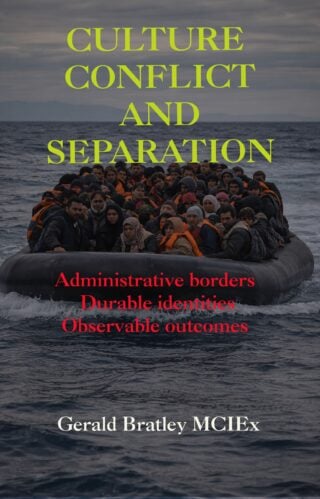
Drawing on historical research and first-hand experience in conflict and post-conflict regions, Gerald Bratley explores how political decisions, migration, identity and territorial division affect communities on the ground.
Over the past century, borders have been drawn, redrawn, and dismantled—often through administrative decisions taken far from the populations most affected. In many cases, culturally distinct communities were placed within shared political frameworks, or divided by them, with limited consultation and uncertain long-term outcomes.
Culture, Conflict, and Separation is a fact-driven examination of what followed.
This book brings together two complementary strands of analysis:
First, it surveys modern conflicts and partitions (1925–present), distinguishing wars driven primarily by strategy or ideology from those in which cultural, religious, or ethnic identity became the dominant force. It then presents detailed comparative case studies—including Czechoslovakia, Yugoslavia, India–Pakistan–Bangladesh, Lebanon, Syria, and the Arab–Israeli/Israeli–Palestinian conflict—focusing on administrative creation, governance structures, fracture points, and outcomes.
Second, it examines post-war migration and asylum into the United Kingdom, documenting who arrives, how they arrive, and under what legal and administrative frameworks. Drawing on Home Office data and international conventions, it differentiates between refugees, asylum seekers, and economic migrants, and records settlement patterns, accommodation systems, and costs—without advocacy or prescription.

In beta – Built with you, for you.
ReaderVerified is currently in beta—meaning we’re still growing, improving, and listening closely to our users. Your feedback helps shape the future of this platform, and we’d love to have you along for the ride. Try it out, tell us what works, and let’s build something brilliant together.
Frequently asked questions
Your reviews, and all the reviews on Readerverified, are written by your peers —fellow authors who want to see you succeed.
When you submit your Amazon-Verified email link, it will prove that you purchased the eBook you read and reviewed from Amazon.
All reviews are Amazon-Verified reviews because we insist that all of our members purchase the ebook that they are reading and reviewing on Amazon for $2.99. This policy will be moderated by ReaderVerified.
