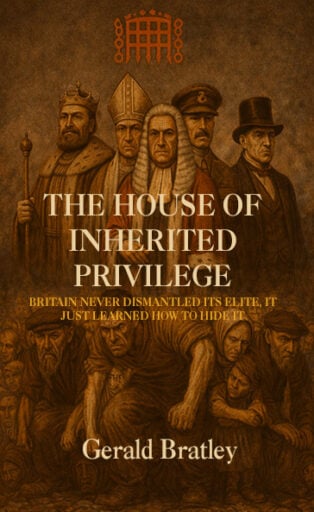
The House of Inherited Privilege
How can I review this book?
Select 'Agree to review' for the book you want to review. We'll provide you with the link to buy the book on Amazon for $2.99 (ePub).
Next, simply read the book.
Submit a thoughtful review on Amazon that's constructive and, most of all, genuine. *Begin all of your reviews: "My readerverified score is ___ %."
Amazon will send an email confirming your verified review was posted successfully. Once you have this, select "See your full review". Then copy and paste the URL / website link and drop it in an email us reviews@readerverified.com
We’ll add it to ReaderVerified along with your ReaderVerified score %.
About the book
Tracing the connections between land, wealth, compensation, education, Parliament and government, Gerald Bratley asks how far Britain can be considered fully democratic while unelected and hereditary power remains embedded within its institutions.
This book examines a thousand years of British history through a single, often unasked question: not what changed, but what endured.
Beginning with land ownership after the Norman Conquest, it traces how wealth, authority and political influence became concentrated — and how those advantages were repeatedly protected when challenged. Parliament, enclosure, empire, industrialisation, compensation schemes, welfare, education and constitutional reform are examined not as isolated events, but as connected mechanisms within a long-running settlement.
The book shows how:
land ownership became the original source of political power
Parliament evolved as a protector of property rather than a representative of people
elite losses — from the American War of Independence to the abolition of slavery — were compensated by the state and paid for by the public
reform expanded participation without redistributing power
unelected authority adapted through the House of Lords and the Cabinet
education widened access while limiting understanding of how power operates
Drawing on documented laws, institutions and historical patterns, this is not a polemic and not a conspiracy theory. It does not argue what Britain should become, nor does it offer ideological solutions. Instead, it connects evidence that is rarely presented together and invites the reader to draw their own conclusions.
Britain’s history is often told as a story of gradual progress. This book asks whether that progress was designed to change outcomes — or to preserve them.

In beta – Built with you, for you.
ReaderVerified is currently in beta—meaning we’re still growing, improving, and listening closely to our users. Your feedback helps shape the future of this platform, and we’d love to have you along for the ride. Try it out, tell us what works, and let’s build something brilliant together.
Frequently asked questions
Your reviews, and all the reviews on Readerverified, are written by your peers —fellow authors who want to see you succeed.
When you submit your Amazon-Verified email link, it will prove that you purchased the eBook you read and reviewed from Amazon.
All reviews are Amazon-Verified reviews because we insist that all of our members purchase the ebook that they are reading and reviewing on Amazon for $2.99. This policy will be moderated by ReaderVerified.
